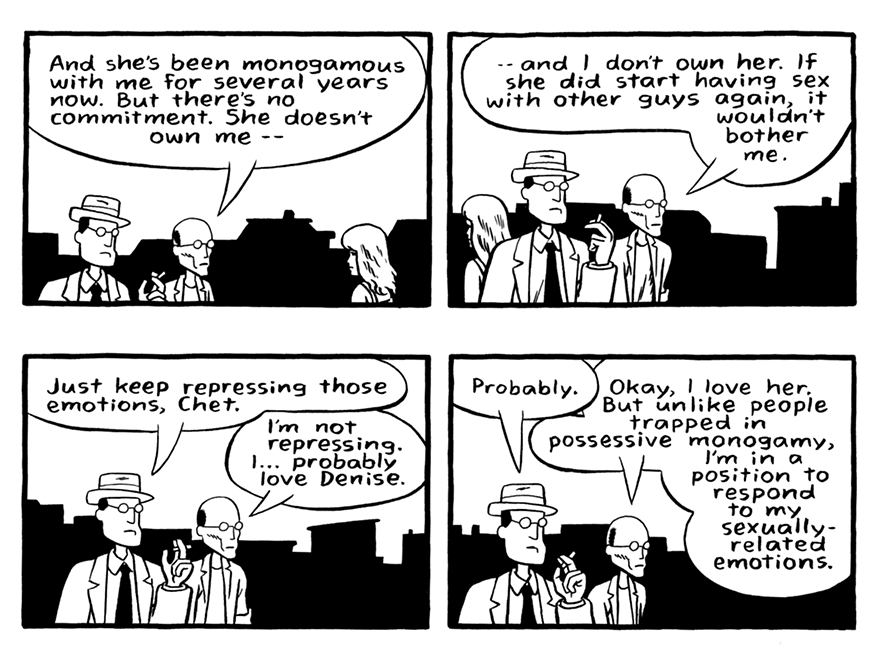
Elijah J. Brubaker is a talented cartoonist who first came to my attention via the ever reliable Sparkplug Comics. To date, Sparkplug have published eight issues of his biographical series 'Reich', which follows the life and work of the radical psychiatrist and psychoanalyst Wilhelm Reich, as depicted by Brubaker's spare, elegant artwork. Reich's scope spans both decades and continents; from pre war German liberalism to the post war conformity of Eisenhower’s America; following Reich’s controversial work within its strictures. It's a gripping comic that deserves a wider readership. Elijah kindly took the time to answer some questions about himself and his work, revealing a great deal about both in the process.
Exquisite Things: How long have you been working as a cartoonist?
Elijah: Like most cartoonists, I've been doing it my whole life. It's hard to define a place when you jump from someone who likes to write and draw in your sketchbook to that of a working cartoonist. The job generally pays about the same either way, so you can't use that as a marker.
I guess I've gone through steps as a cartoonist, and they're slow steps too. When I bought my first hardbound sketchbook, that was one step as a cartoonist. Hell, switching from crayon to pen was a step. There are so many steps that lead you to what you are. I think the sketchbook thing was my first real conscious effort to become a cartoonist: that was somewhere around 1992. A few years later my sister helped me print a huge print-run of an embarrassing comic. It was awful, but I was so proud at the time.
It really wasn't until recently though, that I think my skill and my ambition are creeping close enough that I can call myself a cartoonist. I have no education at all so it's taken me a long time to hone my skills, even to the rough level they are now. I'm sure in another twenty years I'll produce a good comic. Right now though, it's all study and practice.
Exquisite Things: How did you first become interested in comics? Was it something you had always wanted to pursue?
Elijah: Yes, always. Kids draw comics naturally. It's just an efficient way of communicating. If you don't know a word for something, you can draw a picture of it. If you draw a picture of a cat and no one knows what it is, you put a label on it that reads "cat." Growing up though, you realize that Marshal McLuhan was wrong and the medium isn't the message. You begin to look for stories to tell with your chosen form. Like most American kids my age, I read superhero books. For a time I imitated the stories I was reading and I thought I could draw superheroes and action/adventure.
I read underground stuff too because my mom was a hippy and there was always some “Freak Brothers” laying around. I was too young to get the jokes but I liked the drawings. So my earliest stories were a bizarre amalgam of underground and mainstream comics. Eventually I became interested in drugs and girls so my comics meandered firmly over to the underground camp and pitched a tent there for years.
 Exquisite Things
: What other comics/stories have you produced besides 'Reich'?
Elijah: I did a few zines and minicomics in small runs before I started drawing 'Reich'. I was part of a group of cartoonists in Seattle that put out an anthology called “Moxie” for a couple of issues. I had a piece in Robyn Chapman and Kelli Nelson's true porn anthology. It was all good practice but looking back at that stuff makes me cringe.
Around the same time Sparkplug picked up 'Reich', I was contacted by Greg Means of Tugboat press and offered a spot in the “Papercutter” anthology. I had twenty-something pages in “Papercutter” #3. That and 'Reich' are the two stories I can point to and say "look, I'm a cartoonist". Since then I've put short work in a few places like Portland's “Stumptown Underground” zine and I've been putting out issues of my minicomic “Blue Moon”. I just printed issue 5 after a few years away from it.
Exquisite Things: Why a biographical comic about Wilhelm Reich? What was it that drew you to Reich as a topic?
Elijah: I had this ridiculous notion that doing a biography would be easier in some way. I'm generally more confident with my writing than my drawing ability, so I wanted to constrain my writing to non-fiction so I could focus on the drawing more. I chose Reich as a subject because he was semi-obscure.
There was enough written about him in English that I could do the research but most people haven't heard of the guy. I didn't want to cover a subject that was well-trod. It always bothers me when comics are used as a gimmick to get stupid people to read. "Look kids, a biography of President Taft, but it's a comic so you don't have to think as much." I felt like my book might fall into that trap if I covered a more well-known figure. And of course, the most important criteria I had was, the story had to be interesting. I'm one of those jerks that thinks everyone's lives are interesting in some way but I really wanted a subject with some meat on it. Reich's story has all these twists and turns and intrigue and madness and science and hokum, all the stuff I love.

I've been interested in Reich since I was a kid but it was a pretty superficial interest. I read something by William Burroughs where he spoke of the Orgone accumulator. Burroughs had a knack for writing about everything with the same acid-tongue prose, it's difficult to parse the truth from fantasy. At first I assumed that a mad scientist creating an "orgasm machine" was something Burroughs had created from his subconscious. I did a little more research, learned the cursory story of Reich and left it at that.
It's a romantic notion that a man can be so sexually liberated that he winds up in jail for it. It's the kind of story that is good to have in your mind as a teenager. The story of Reich kicked around in my brain alongside Jean Genet, De Sade, Henry Miller, Anne Sexton, Kathy Acker etc. Yeah, that's the kind of kid I was. Eventually I began to read more and more about Reich and the less romanticized parts of his story began to hold sway with me. I began to see Reich as a person and less a set of ideals.
 Exquisite Things
: How much time did you spend doing background research? Having attempted to find information about Wilhelm and Peter Reich myself, I know it's a somewhat daunting task. Were there any significant barriers to finding what you needed?
Elijah: I've read most of the material on Reich available in English. The biggest barrier I had in my research was the language barrier. I know a little German and Google translator helps sometimes but there's a lot of Reich's untranslated writing I haven't read.
I did read through Reich's entire FBI file which was pretty much a wash. It's no longer available through fbi.gov but I think you can find it elsewhere. I've read every article and book I could dig up about Reich or his work within his lifetime. I have very little interest in the people that are continuing his work. There are a lot of Reichians out there and their work is interesting, but my focus is Reich as a person, and current Reichian techniques don't help me understand that part of him.
You mention Peter Reich, whose book “A Book of Dreams” is probably the most emotionally wrenching account of the Reich story. It's the only book in my research that I would recommend to a casual reader. I've tried to learn more about Peter Reich but there's very little information available on the internet about him.

Exquisite Things: Were there any particular biographical comics that you looked to for inspiration?
Elijah: I credit Chester Brown's 'Louis Riel' book in the first issue of 'Reich' but I really regret doing so. Not that the book wasn't an inspiration to me, but I don't think the two books have very much in common. I read a recent review of 'Reich' and the critic said something about how Brown's influence is still evident. It's a small thing and I should take the comparison as a compliment but 'Reich' is absolutely nothing like 'Louis Riel'.
They are both biographies with notation, I use a six panel grid in some of the book and my issues are 24 pages long, those are the things our books have in common. This is off topic but I sort of regret putting the notes in the back too. I sometimes hear 'Reich' referred to as historical fiction because of the way I diverge from the accepted facts but most people wouldn't see that divergence if I hadn't put those notes in the back, pointing it out. Anyway, that's my rant against lazy critics not my answer to your question.

The other, obvious influence on 'Reich' is 'Epileptic' and 'Babel' by David B. Again, the books are very different in most ways but his enthusiasm for drawing really took hold of me and influenced certain ways I told the story. There are some panels in Reich, especially early on, where the drawings closely resemble David B. I will probably be redrawing those panels if and when the book is collected. There are a few panels where I appropriate another artist’s work to make a point and I felt the David B panels were in that vein but now, I think it was a mistake.
Not really a biography and not obvious at all as an influence was 'Boulevard of Broken Dreams' by Kim Deitch. That book is amazing and really under-appreciated, I think. Everything Deitch does is reallygood, he's a master.
Exquisite Things: What advantages do you feel the comics medium offers over a normal prose biography in telling Reich's life story?
Elijah: I don’t think comics are better or worse suited to telling the type of story I have to tell. I don't play with the medium in any formal way. Comics are just my chosen form of expression usually. Whenever I write anything, a story, a blog post, a grocery list, I always think "this would be better as a comic."
I'm not sure why I feel that way. Comics just seem more rich and fruitful to me. I do think my book has an advantage as a biography because it's a novelty still, in comics to do something like that. It's also a novelty in that, if I wrote a prose biography of Reich, it would be lost pretty easily among the other books about him.
Originally I thought Reich's story would be perfect for comics because there are so many aspects to his life that would just be a blast to draw. There's post Weimar era Germany and Nazis and sex and riots. Sigmund Freud is a great image all by himself. There's space-guns and flying saucers and atom bombs and all this great shit. Eventually though, I kind of scaled it all back in order to keep the story even-keeled. I didn't want the character of Reich to get lost in all the wild imagery. Even when I get to draw UFOs, I'm pretty reserved about it.

Exquisite Things: What has pleased you most about the comic so far? And what do you hope to achieve with the issues that remain?
Elijah: I'm generally very happy with the way the book has come out. I'm sure there are Reichians out there that would disagree, but I think I show a pretty even-handed view of Reich's life. In upcoming issues where I deal with some of the more controversial aspects of his work I think I maintain a sympathetic approach to Reich. On a personal level this book has taught me so much.
I think I'm a better cartoonist now than when I began. I have a more nuanced and thorough understanding of certain areas of history. The creation of this book has been a huge learning process. What I hope to achieve with the rest of the issues is just to tell the story in a fulfilling way. I hope the people that have been along for the ride won't be disappointed. Anyone out there can find out the events of Reich's life by reading a wikipedia article but I hope the way I tell Reich's story has more meat to it. I hope people can connect to it and to Reich on some emotional level.
We’ll see.
Interview by Kevin McCaighy.Quick Links:
Elijah J. Brubaker's BlogSparkplug Comics